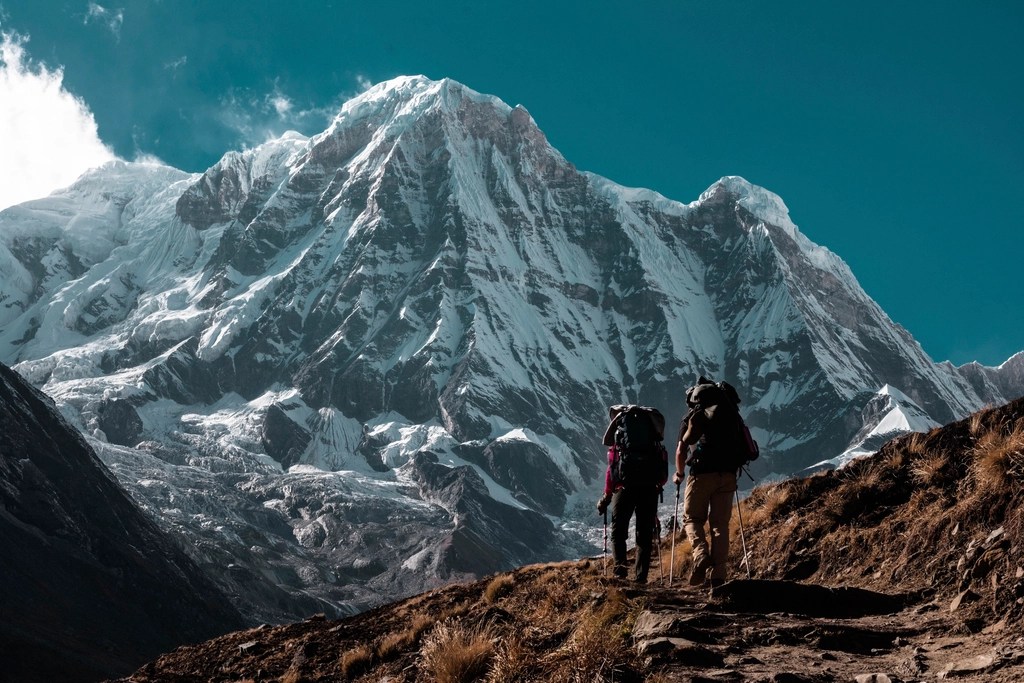
Dhanbader brought a small daypack containing all that he would need on our nine day trek. He was my guide to Annapurna Base Camp at 4.130 meters altitude in the Himalayas. Dhan came prepared to carry my backpack, but I had been sure to pack no more than I could carry myself. Amused he allowed me to carry my own luggage, himself now traveling light as a feather.
The Nepalese Dhan had lost sight in his left eye on a treacherous snow trek 22 years ago, during which he had saved a female tourist’s life. He had survived many a bigger adventure than me. Together we embarked on a trek that would teach me about absolute natural beauty as well as danger – and about the socioeconomic status quo in the Himalayas
At the start of our trek we were enveloped by green valleys and small towns with vegetable farms. People in traditional and colourful Nepalese clothing and woolen beanies glanced at us without much interest. Local school children surpassed us swiftly up or down the hills. Every now and again we stepped aside to allow for a row of donkeys or horses to pass us on the narrow path.
Dhan hiked as if he was having a rather casual stroll, while I was struggling to find my pace. In a rhododendron forest, with pink and red flowered trees, Dhan showed me how to drink nectar from the flowers. “Local medicine”, he explained, “very good for throat”.
After two days of hiking we reached Poon Hill, a village on a similarly named mountain. With its 3.200 meters altitude Poon Hill can indeed be considered a hill next to the Himalayas, of which mountains can reach up to 8.000 meters. Before sunrise the next day we hiked to the top of Poon Hill. The view was already worth the whole trek. To the Nepalese a beautiful place is a sacred place. Colourful Buddhist prayer flags played in the wind at the top of Poon Hill.
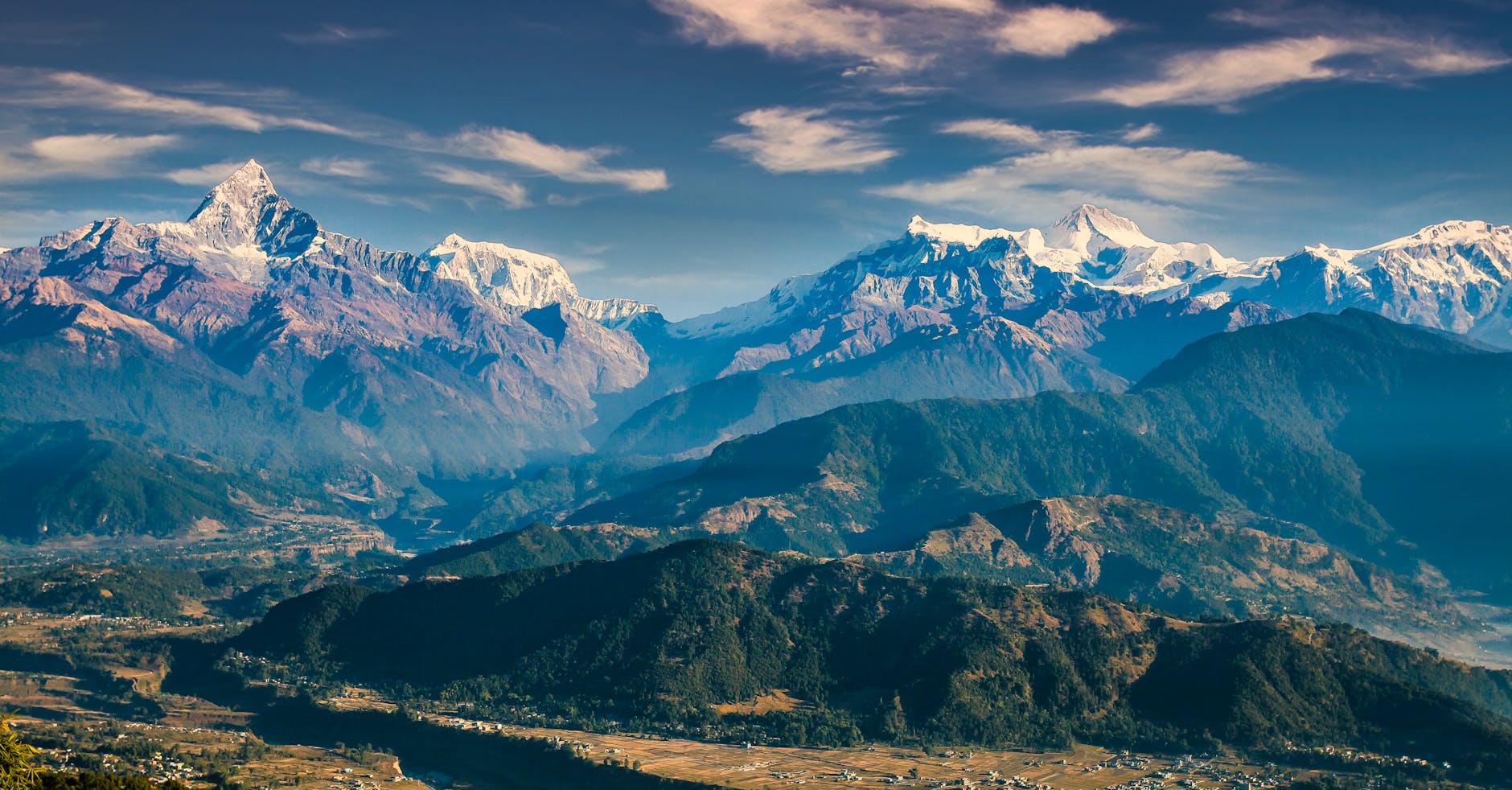
Straight ahead in the distance lay the Annapurna mountain range. In the middle towered the two tops of Machhapuchchhre Himal; a 7.000 meter high mountain with the nickname of Fishtail. Those who climb it are said to never return. Behind Fishtail’s left side lay Annapurna III: the mountain we were to partially climb to reach Annapurna Base Camp, our destination.
Over the next three days we did not gain height. We hiked hundreds of meters up and down every day, but by nightfall we always made it back to a village at around 3.200 meters. Every town we passed seemed to have its own beliefs and superstitions. In one town we were not allowed to eat meat in the next it was forbidden to play music, another town allowed no fires.
In the evenings foreign trekkers and Nepalese guides shared stories. Laughter was often heard. At night we slept in different dorms. Freezing nights had me tuck away in my sleep sack, dressed in my woolen Nepalese hat, socks, gloves and jacket. On top of me always multiple woolen blankets. Still I felt cold and hardly slept; something I easily shook off admiring the towering mountain range in the mornings. However, I noticed that the guides’ dorms sometimes didn’t offer a single blanket. Every time I mentioned this or suggested to divide the available blankets between us, Dhan avoided the subject. This was uncharacteristic for his talkative nature.
We reached a centimetre of snow on our fifth day of trekking. Our excitement quickly changed to vigilance when descending trekkers told us that the snow was ‘pretty bad up there’ and that ‘one group has lost three of its members in an avalanche’. We continued hiking through the thin layer of snow until we reached the town of Deurali, of course situated 3.200 meters.
Time-wise we could make it to Machhapuchchhre Base Camp (MBC) at 3.900 meters in two hours that same day. It would then be another two hours from MBC to Annapurna Base Camp (ABC) at 4130 meters, our destination. But more news of avalanches on exactly these trails reached us. I even got told that this was the worst avalanche region in Nepal – something that definitely had not been printed in my guide book. We decided to spend the night in Deurali.
The snowfall continued. It started to get very cold. The owner of the guest house place a heater under the table, at which I was seated with a group of Chinese trekkers and their Nepalese guide. It was the guide’s birthday that day and the Chinese spoiled him and us with food as per their national custom.
‘We are descending tomorrow’, one of them told me. They had attempted to reach MBC from Deurali this afternoon, but had been forced to return because of the weather. ‘Look, we’ve got it on video.’ A small screen on a digital camera showed a grey cloud blocking the view as it came in from the valley at high speed. Another video showed an avalanche on the other side of the valley, with people screaming in the background. The group had concluded that it was way too dangerous to hike any further. They would descend the next day.
Five trekkers were missing now. The topic caused a grave silence between us. Today we had learned that the track between Deurali and MBC is the biggest avalanche danger zone of Nepal. Of this I previously had no idea and neither had my guide book. That evening the guide of the Chinese group received a phone call, saying that the people at both Machhapuchchhre and Annapurna Base Camp were snowed in and stuck there.
Dhanbader’s name is a combination of the words ‘strength’ and ‘rice’. Dhan knows the mountains very well. He did not give up hope yet and said we would see what the path would look like in the morning. Dhan told us that walking in an avalanche danger zone is best done before 8 AM, when the sun hasn’t warmed up the snow enough yet in order for it to melt and fall. I wondered whether we should walk in an avalanche danger zone at all. Nevertheless, the next morning at 6 AM we were ready. But at that time the snowfall had returned and even Dhan had to admit defeat.
One centimeter of snow had become twenty centimeters overnight. I felt no disappointment. I was lucky. Those five people who were missing, was someone even looking for them? No helicopter could fly in this weather. As for us: we could neither proceed up nor walk down. So we sat around the table again with the Chinese. This time without the heater. There was tension in the room. I sipped a mug of watery hot cocoa as I tried to focus on a book to pass the time.
Fortunately for us only a few hours later the snowfall decreased. We seized our chance and began a fast descend. Dhan and I were jumping through fresh snow and surpassed people who were walking very carefully. Only once I fell on the slippery path. When this happened, Dhan walked back to me and pointed up at the open areas in between the trees. “Also avalanche danger zone”, he said softly. I was now starting to recognize the danger zones and realized our continuous risk. He wanted to get us out of here as soon as possible.
I noticed snow on the ground at much lower altitudes than the day before. Many hours passed before the snowfall turned to rain. Taking few breaks, we descended through the rain the rest of the day. We reached the first perceived safe town in the evening: Chomrong. After we checked in to a guest house, we found many more trekkers who had stranded here on their way up or down.
On the first day in Chomrong many of us huddled up in our sleeping bags in a common room as our wet backpacks and clothes were drying. Dhan estimated it would not be possible to hike up for the next three weeks. On the second day the sky cleared up and three helicopers flew in. We watched them disappear into the deeper mountains. They managed to rescue the people who had been stuck in the base camps. Some people were dropped off in Chomrong, others were taken to hospitals in Pokhara and Kathmandu. We learned that the path on which we had walked down only two days before, had been hit by a few avalanches and was no longer accessible. The five missing people had died. Another person had died of high altitude sickness when she did reach ABC.
On this second day we decided to pack up our wet belongings and continue our descend. We walked for another eight hours, leaving the sound of the helicopters far behind us. This is when Dhan told me about the difference in rescue operations for tourists and local people. For a tourist a helicopter rescue is always arranged as it is often covered by insurance. But the Nepalese guides, sherpas and inhabitants of the mountain villages had no way of affording a helicopter rescue when being hit by an avalanche or getting stuck because of one. Neighboring towns first had to collect money in order to send a search helicopter, which of courses costs precious time. The risk that the Nepalese took in the Himalayas was of a different level than my own. I had not been quite aware of that.
Trekking in the Himalayas was one of the most beautiful experiences of my life. Yet I learned how ill prepared we can enter some areas as a tourist and by doing so even endanger others. Sometimes we do not realize how little we know about potential hazards in an area unfamiliar to us.
This was not the last time that I would learn this lesson in Nepal. Increased tourism makes more places easily accessible, which opens up opportunities as well as risks. For both tourists and local people. It is so important to realize that there are many things about new places that we do not know. And that we cannot know until we experience them or talk to (local) people who have done so.
 Samantha Zuidam